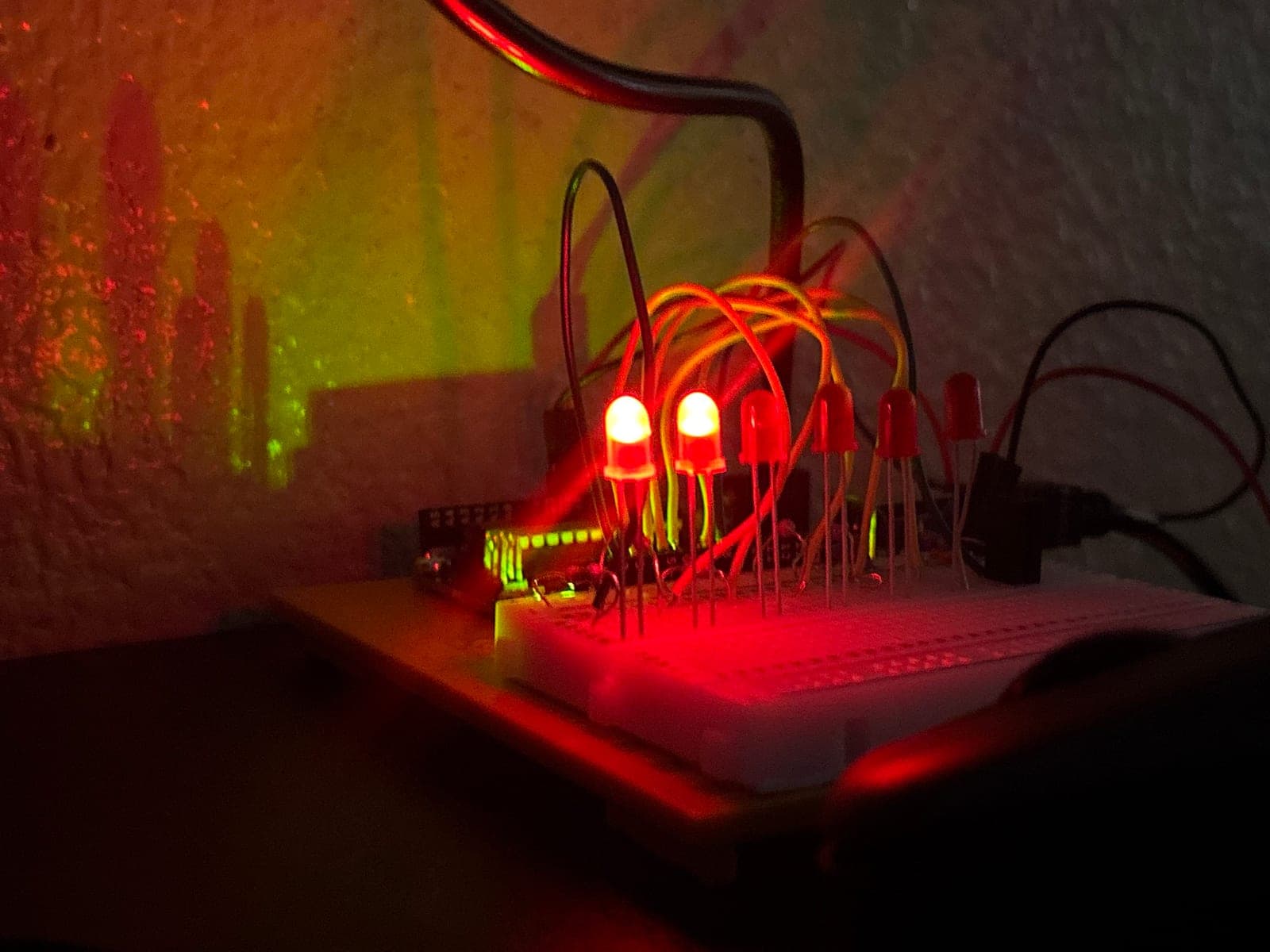
10-minute interval timer
Working prototypeAn Arduino timer that lights one of six LEDs every 10 minutes, prototyped on a breadboard.
- Based on the Digital Hourglass project from the Arduino Starter Kit, then modified.
- Uses millis() instead of delay() for timing, so the board keeps reading the tilt sensor while it counts.
- When all six LEDs are lit (one hour), the row clears and the count starts over.
- Tilting the board resets the timer.
What I tried after
- Reprogrammed the LEDs to flash in the rhythm of the Jingle Bells chorus.
- Changed the time periods to see how the timer behaved at different intervals.
- Reworked the reset so it runs without the tilt sensor, making the timer fully automatic.
Arduino, C++, Breadboard prototyping
View the timer code
interval_timer.ino
const int switchPin = 8;
unsigned long previousTime = 0;
int switchState = 0;
int prevSwitchState = 0;
int led = 2;
unsigned long interval = 600000; // 10 minutes per LED

void setup() {
  for (int x = 2; x < 8; x++) {
    pinMode(x, OUTPUT);
  }
  pinMode(switchPin, INPUT);
}

void loop() {
  unsigned long currentTime = millis();

  // Every interval, light the next LED.
  if (currentTime - previousTime > interval) {
    previousTime = currentTime;
    digitalWrite(led, HIGH);
    led++;

    // After the sixth LED, clear the row and start over.
    if (led == 8) {
      delay(1000);
      for (int x = 2; x < 8; x++) {
        digitalWrite(x, LOW);
      }
      led = 2;
      previousTime = millis();
    }
  }

  // Tilting the board (tilt sensor on pin 8) resets the timer.
  switchState = digitalRead(switchPin);
  if (switchState != prevSwitchState) {
    for (int x = 2; x < 8; x++) {
      digitalWrite(x, LOW);
    }
    led = 2;
    previousTime = currentTime;
  }
  prevSwitchState = switchState;
}
View the Jingle Bells code
jingle_bells_lights.ino
const int beat = 350;  // Smaller = faster

// Relative note lengths for the chorus.
// 0 marks a pause between phrases.
const int rhythm[] = {
  1, 1, 2,  1, 1, 2,  1, 1, 1, 1, 4, 0,
  1, 1, 1, 1, 1, 1, 1, 1, 1, 1, 2, 2, 0,
  1, 1, 2,  1, 1, 2,  1, 1, 1, 1, 4, 0,
  1, 1, 1, 1, 1, 1, 1, 1, 1, 1, 4
};

void setLights(int state) {
  for (int pin = 2; pin <= 7; pin++) {
    digitalWrite(pin, state);
  }
}

void setup() {
  for (int pin = 2; pin <= 7; pin++) {
    pinMode(pin, OUTPUT);
  }
}

void loop() {
  int count = sizeof(rhythm) / sizeof(rhythm[0]);

  for (int i = 0; i < count; i++) {
    if (rhythm[i] == 0) {
      setLights(LOW);
      delay(beat);
    } else {
      int duration = rhythm[i] * beat;

      setLights(HIGH);
      delay(duration * 3 / 4);

      setLights(LOW);
      delay(duration / 4);
    }
  }

  delay(1500);  // Pause before repeating
}